
Constitutional Hermeneutics: The Bible and the Four Corners of the Text

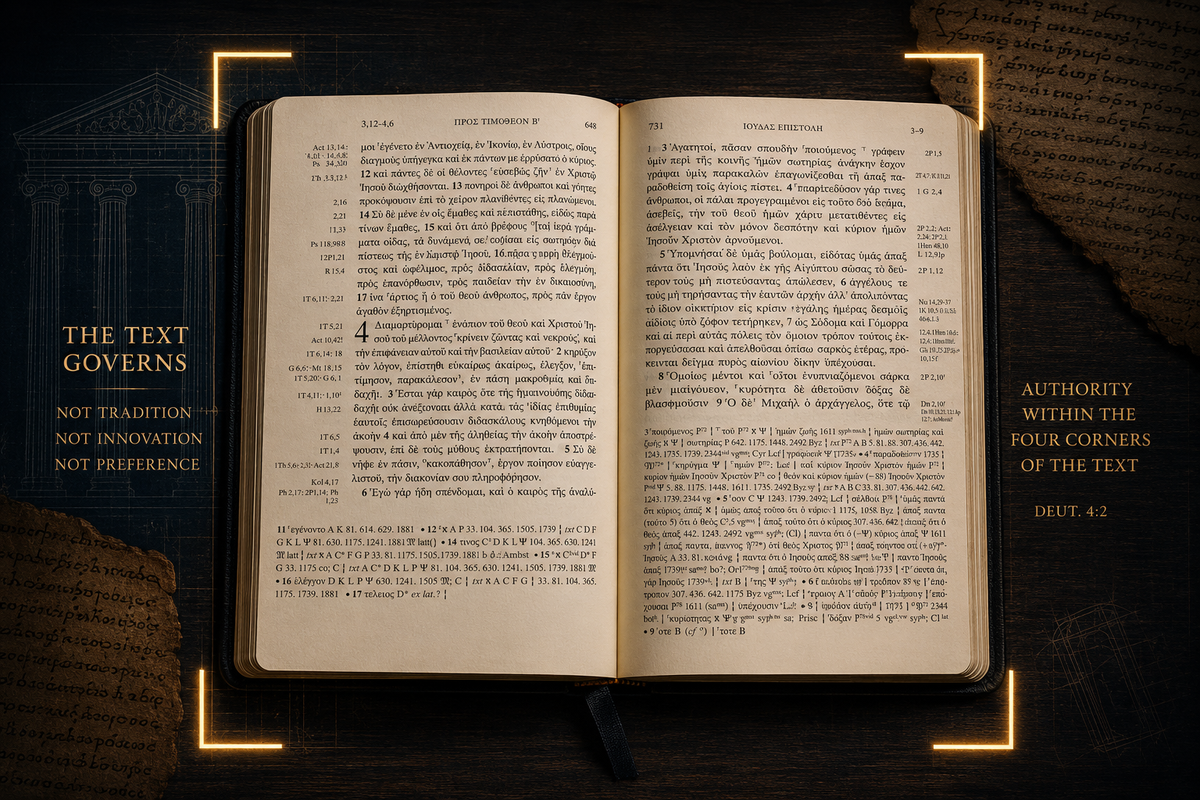
This essay was written by Shawn D. Mathis, PhD, MSc (Oxon), MA, who serves as an elder at the Nashville Church of Christ. His work focuses on theology, hermeneutics, philosophy of language, and questions of scriptural authority within the Restoration heritage.
The crisis confronting modern Christianity is not fundamentally political, sociological, or even moral. It is a crisis of authority. The question is no longer merely whether Christians believe the Bible. The question is whether the church still believes Scripture governs its faith, doctrine, and practice.
For much of its history, the Churches of Christ answered that question with notable clarity. Scripture functioned as the church’s governing apostolic witness. The church understood itself to stand beneath the revealed word of God preserved within the apostolic writings. The Bible was not treated merely as inspirational literature, theological reflection, or a repository of religious experience. Rather, the church understood itself to remain accountable to the authority of the revealed text, even while interpretation required grammatical, historical, literary, and theological judgment.
That understanding is now increasingly questioned, including within portions of the Restoration Movement itself. Text-centered readings of Scripture are frequently dismissed as “legalistic,” “procedural,” or insufficiently sensitive to literary complexity and theological development. Appeals to biblical authorization are often treated with suspicion, while apostolic silence is interpreted more permissively than in earlier Restoration thought. The older Restoration emphasis upon textual boundaries is now frequently caricatured as intellectual rigidity rather than recognized as a coherent doctrine of ecclesial authority.
Advocates of more permissive or developmental hermeneutics frequently argue that Scripture itself emerged within historically dynamic covenantal contexts and cannot be reduced to static constitutional categories alone. In ways structurally analogous to certain forms of living constitutionalism, such approaches emphasize ecclesial discernment, canonical development, redemptive trajectory, literary complexity, and the church’s ongoing responsibility to interpret Scripture within changing historical circumstances.
What governs the church—Scripture or the interpreter? If Scripture is the revealed word of God, then the church does not possess authority to revise or supplement apostolic revelation according to contemporary preference. Within classical Restoration hermeneutics, divine revelation has historically been understood to delimit the church’s authority to revise or supplement apostolic teaching beyond the boundaries established within the text itself. That principle lies at the heart of both textual originalism and historic Restoration hermeneutics. Constitutional originalism within the United States Constitution similarly argues that authoritative meaning remains anchored within the text as canonically or publicly given.
Proponents of text-centered hermeneutics argue that such an approach remains hermeneutically coherent, philologically rigorous, canonically grounded, and consistent with Scripture’s own self-presentation as authoritative divine speech. An originalist reading of Scripture does not flatten literary genre, deny historical context, or ignore linguistic nuance. It insists instead that interpretation remains accountable to the text God actually gave. Proper hermeneutics recognizes that interpretation is unavoidable while insisting that interpretation itself remains accountable to the grammatical, historical, literary, and canonical dimensions of the document.
The biblical canon has historically been interpreted within Christian theology as presenting itself as authoritative divine speech rather than merely human religious reflection. If Scripture is truly “God-breathed”—θεόπνευστος— (2 Tim. 3:16), then the church does not stand above revelation as its revising authority. It stands beneath revelation as its steward.
The biblical canon consistently presents itself not merely as human reflection about God, but as divine speech communicated through human agents and preserved in written form. The broader theology of Scripture as divine speech is explored further in Recovering a Theology of Scripture as Divine Speech in an Age of Relativism.
Deuteronomy establishes one of the clearest textual boundaries in Scripture when the covenant explicitly prohibits adding to or subtracting from the commanded word:
“you shall not add to the word … nor take away from it” (οὐ προσθήσετε πρὸς τὸν λόγον … οὐδὲ ἀφελεῖτε ἀπ’ αὐτοῦ; Hebrew: לֹא תֹסִפוּ עַל־הַדָּבָר … וְלֹא תִגְרְעוּ מִמֶּנּוּ, Deut. 4:2, Rahlfs-Hanhart LXX).
For a full discussion, see The Hebrew Scriptures as Divine Speech: A Study of Authority, Inspiration, and Canon.
Within bounded theories of revelation, divine disclosure is understood to establish limits upon the covenant community’s authority to revise or supplement the revealed word. It stands beneath revelation as its steward. This helps explain why the historic Restoration Movement approached Scripture through the “four corners” of the text itself.
Constitutional originalism begins with a straightforward premise: the text governs. As articulated in Antonin Scalia’s A Matter of Interpretation, judges are not authorized to revise constitutional meaning according to evolving cultural preference. Constitutional originalism argues that authoritative meaning remains anchored within the text as publicly given rather than perpetually reconstructed through evolving interpretive preference. Interpretation is unavoidable in every textual community; interpretive autonomy is not.
Historically, Restoration hermeneutics operated according to structurally similar principles of bounded textual authority. Scripture was approached not as a living constitutional framework whose meaning perpetually evolves through reinterpretation, but as an authoritative apostolic witness entrusted to the church.
One of Scalia’s central objections to modern constitutional theory involved the gradual transformation of constitutional interpretation into a form of common-law reasoning in which judges progressively reshape the meaning of the text through accumulated interpretive development.
Once authoritative meaning becomes untethered from stable textual boundaries, interpretive communities increasingly become the functional locus of authority. Portions of modern biblical hermeneutics exhibit similar tendencies as Scripture becomes increasingly shaped through ecclesial negotiation and contemporary theological preference.
At its core, the debate concerns the locus of ecclesial authority: whether authority remains primarily textually grounded or increasingly mediated through interpretive communities and evolving hermeneutical frameworks.
Jude writes:
ἐπαγωνίζεσθαι τῇ ἅπαξ παραδοθείσῃ τοῖς ἁγίοις πίστει
“to contend for the faith once for all delivered unto the saints” (Jude 3, NA28).
This helps explain the historic Restoration plea:
“Speak where the Bible speaks, and be silent where the Bible is silent.”
Authority was understood to remain bounded by the revealed text. The church could not treat institutional utility, majority sentiment, or pragmatic effectiveness as independent authorities capable of revising apostolic revelation itself. Worship, doctrine, congregational organization, and ecclesial practice required apostolic grounding because the church understood itself to be governed by revelation rather than institutional innovation.
One common objection to originalist or constitutional readings of Scripture appeals to the diversity of literary genres within the biblical canon. Because the Bible is not composed exclusively of legal commands, some conclude that it cannot function authoritatively in any meaningful textual or covenantal sense.
No serious originalist argues that every sentence of the United States Constitution functions identically. Constitutional interpretation already distinguishes among preambles, prohibitions, procedural clauses, enumerated powers, declarations, and amendments. See the Stanford Encyclopedia of Philosophy: Legal Interpretation. Genre does not abolish textual authority; it shapes how textual authority is interpreted.
Genre shapes interpretation without dissolving textual authority. Literary sensitivity does not weaken an originalist hermeneutic; it disciplines it. Poetry must be read as poetry, apocalypse as apocalypse, narrative as narrative, and command as command. Yet interpretation remains accountable to the text actually given rather than liberated into autonomous ecclesial reconstruction.
| Hermeneutical Issue | Common Objection | Constitutional Response | Hermeneutical Implication |
|---|---|---|---|
| Scripture as Constitutional Authority | The Bible is not a legal code, so it should not be read constitutionally. | A document need not consist exclusively of legal commands in order to exercise governing authority. Constitutions themselves contain preambles, declarations, prohibitions, grants of power, and procedural rules. | Literary genre shapes interpretation without eliminating textual authority. |
| Scripture as Governing Authority | Modern circumstances require flexible and evolving interpretation. | If evolving circumstances become capable of revising apostolic revelation itself, interpretive discretion increasingly displaces the governing authority attributed to the text. | Ecclesial authority is understood as remaining subordinate to revelation. |
| Apostolic Silence and Ecclesial Authority | Where Scripture does not explicitly forbid a practice, the church possesses liberty to adopt it. | Within constitutional hermeneutics, delegated bodies are not understood to possess authority to establish doctrine, worship, or ecclesial structures beyond what revelation authorizes. | Ecclesial authority remains bounded by the limits of revealed authorization. |
| Apostolic Authority and Prudential Implementation | Constitutional hermeneutics requires reproducing every first-century operational form. | Constitutional approaches generally distinguish between apostolic revelation itself and historically conditioned means of administration, communication, stewardship, and institutional operation. | Revelation may remain textually fixed while operational implementation adapts prudentially. |
| Literary Genre and Textual Authority | Poetry, narrative, prophecy, and apocalypse demonstrate that Scripture cannot function as a constitutional authority. | Genre identifies how language communicates; it does not relocate authority from the text to interpretive preference. | Literary form disciplines interpretation while preserving textual authority. |
| Institutional Ambiguity and Hermeneutical Authority | Institutions may avoid choosing between constitutional and permissive hermeneutical systems. | Where one framework maintains stable textual boundaries and another permits broader interpretive flexibility, prolonged institutional ambiguity may gradually privilege the more permissive framework. | Institutional identity is often shaped by the hermeneutical assumptions institutions normalize over time. |
Recognizing literary form does not authorize the church to move beyond the boundaries of apostolic revelation. When genre becomes detached from the governing authority of the text itself, interpretive flexibility gradually expands beyond stable textual boundaries. Historically, the Restoration Movement resisted that tendency because it insisted that the church remained accountable to Scripture as authoritative revelation rather than to evolving interpretive discretion. The broader interpretive tensions surrounding that issue are explored further in New Testament Christianity and the Interpretive Crisis of Restorationism.
Perhaps nowhere is the logic of bounded textual authority—and the originalist structure of Restoration hermeneutics—more visible than in the doctrine of restrictive silence. Many modern interpreters treat biblical silence as permissive. If Scripture does not explicitly condemn a practice, the church is assumed to possess liberty to adopt it. Historically, however, Churches of Christ reasoned differently. Silence functioned as a boundary not because every unmentioned possibility was automatically forbidden in abstraction, but because the church understood itself to possess delegated rather than autonomous authority.
The issue is not whether silence possesses some mystical prohibitive quality in itself. The issue is whether delegated covenant communities possess authority to move beyond what revelation positively authorizes.
Deuteronomy 4:2 establishes the underlying theological logic: the covenant people of God are prohibited from adding to or subtracting from the revealed word. Silence becomes restrictive wherever the church seeks to establish doctrine, worship, or ecclesial authority beyond what revelation authorizes. The question is not simplistic prohibitionism, but whether delegated covenant communities possess authority to move beyond the boundaries of revealed instruction. Silence becomes meaningful because ecclesial authority is understood as delegated rather than self-generated.
Congress possesses delegated and enumerated powers within the American constitutional tradition reflected in The Federalist Papers. The absence of constitutional authorization limits governmental action. Likewise, the church historically understood itself to possess delegated rather than autonomous authority. Historically, Churches of Christ sought positive apostolic grounding for doctrine, worship, and ecclesial authority through command, approved example, and necessary inference.
This explains why instrumental music historically became such a defining controversy. The objection was never fundamentally aesthetic. It concerned the perceived boundaries of apostolic authorization in worship. The New Testament authorized singing:
λαλοῦντες ἑαυτοῖς ψαλμοῖς καὶ ὕμνοις καὶ ᾠδαῖς πνευματικαῖς,
ᾄδοντες καὶ ψάλλοντες τῇ καρδίᾳ ὑμῶν τῷ κυρίῳ
“speaking to one another in psalms and hymns and spiritual songs, singing and making melody in your heart to the Lord” (Eph. 5:19, NA28).
It did not explicitly authorize instrumental accompaniment in the assembled church. Once apostolic silence was understood restrictively in matters of worship, the church could not supplement what it understood God to have specified. The church could act within the bounds of revealed authority, but not revise the substance of revealed worship itself. The distinction concerns the alteration of worship and ecclesial authority, not the existence of prudential tools or historically conditioned operational means through which congregations carry out authorized acts.
This does not mean interpretation ceases to exist or that every question is mechanically self-evident. An originalist hermeneutic does not deny interpretation; it denies the autonomy of interpretation from the governing authority of the text. Interpreters necessarily exercise judgment concerning language, genre, context, history, and literary form. The question is what ultimately governs interpretive judgment.
Interpretation is unavoidable in every textual community; interpretive autonomy is not. Originalist hermeneutics does not require wooden literalism or reductionistic legalism. As Antonin Scalia observed in discussions of constitutional textualism:
“A text should not be construed strictly, and it should not be construed leniently; it should be construed reasonably, to contain all that it fairly means” (A Matter of Interpretation [Princeton, NJ: Princeton University Press, 1997], 23).
he hermeneutical significance is substantial. Interpretation remains necessary because language, genre, context, and literary form require disciplined judgment. Yet interpretation also remains bounded because authoritative texts cannot legitimately be made to mean whatever later interpreters prefer them to mean. The issue is not whether interpretation exists, but whether interpretation remains accountable to the text itself.
This principle parallels broader textual theories of authority found in constitutional interpretation and legal philosophy. As Antonin Scalia observed:
“It is the law that governs, not the intent of the lawgiver” (A Matter of Interpretation, 17).
The authority of Scripture rests not in speculative reconstructions beyond the text, but in the revelation actually given and canonically preserved within the text itself.
| Question | Constitutional Hermeneutic | Permissive Hermeneutic | Hermeneutical Implication |
|---|---|---|---|
| Where does authority reside? | Authority remains principally anchored within the text itself. | Authority becomes increasingly mediated through interpretive flexibility that permits broader reinterpretation of apostolic revelation. | Competing hermeneutical systems reflect differing conceptions of ecclesial authority. |
| How is silence interpreted? | Silence functions restrictively in matters of doctrine, worship, and ecclesial authority. | Silence permits practices not expressly prohibited within the text. | The two approaches proceed from differing assumptions regarding delegated authority. |
| What is the role of the church? | To preserve apostolic Christianity while exercising prudential judgment concerning historically conditioned means of carrying out the church’s mission. | To adapt apostolic Christianity according to evolving theological, institutional, and cultural conditions. | The approaches differ regarding the degree of continuity maintained with apostolic precedent. |
| How is genre treated? | Genre guides interpretation while remaining textually bounded. | Genre becomes grounds for broader interpretive elasticity that may expand doctrinal flexibility. | Literary form either disciplines interpretation or expands interpretive flexibility. |
| What governs interpretation? | Interpretation remains subordinate to the governing authority of revelation. | Interpretive judgment increasingly mediates how revelation is understood and applied. | Hermeneutical frameworks disclose differing conceptions of textual authority. |
| How are modern institutional conditions addressed? | Apostolic revelation remains fixed while prudential implementation adapts within textual and ecclesial boundaries. | Contemporary institutional conditions become grounds for broader doctrinal and ecclesial adaptation. | The approaches differ regarding whether adaptation serves or reshapes revelation. |
| What are the institutional consequences? | Doctrinal and ecclesial boundaries remain comparatively stable. | Doctrinal boundaries become increasingly compatible with coexistence-oriented frameworks. | Institutional identity is often shaped by the hermeneutical frameworks institutions normalize over time. |
Portions of modern hermeneutics approach Scripture through assumptions structurally similar to living constitutionalism, in which meaning gradually becomes less tethered to the stabilizing boundaries of the text, authorial intent, and canonical context, much as constitutional meaning can become separated from the text of the United States Constitution. Silence becomes increasingly permissive, while textual boundaries soften beneath the pressures of pluralism, institutional preservation, pragmatism, and cultural accommodation.
At its core, the issue concerns whether the church may move beyond what God has revealed. Classical Restorationism answered no, even if its hermeneutical method may not preserve every historical Restoration application in precisely the same form. Many contemporary hermeneutical approaches approach that question with significantly greater interpretive flexibility.
Originalist hermeneutics is frequently criticized within contemporary interpretive discussions as overly rigid, procedural, or insufficiently attentive to literary and historical complexity. Yet advocates of originalist approaches continue to argue that Scripture possesses a sufficiently determinate meaning within the text itself such that interpretation remains accountable to the revelation canonically given rather than primarily to evolving interpretive preference.
Within Restoration thought, originalist or text-governed hermeneutics has historically emphasized original meaning, textual authority, and the conviction that the church remains subordinate to rather than constitutive of revelation.
What is described here as an originalist — “the four corners of the document” — hermeneutic functions fundamentally as a theology of revelation before it functions as an analogy to constitutional law. Scripture has historically been interpreted within these frameworks as divine speech, and texts such as Deuteronomy 4:2 have frequently been understood as prohibiting both addition to and subtraction from the revealed word. The constitutional analogy therefore functions illustratively rather than foundationally. It provides one contemporary conceptual framework for describing the older theological conviction that covenant communities remain accountable to the revelation God has given.
Contemporary originalist approaches within Restoration scholarship increasingly distinguish between apostolic revelation itself and the historically conditioned means through which congregations carry out teaching, administration, communication, stewardship, and institutional operation. Within this framework, technological, legal, financial, and organizational developments are not necessarily understood as revisions of apostolic revelation unless they alter the substance of doctrine, worship, ecclesial authority, or moral teaching.
The modern church inevitably operates within legal, economic, technological, and institutional conditions unknown to the first-century world. The existence of nonprofit corporate structures, banking systems, accounting requirements, digital communications, software infrastructure, and global operational logistics does not necessarily constitute doctrinal revision within constitutional approaches to hermeneutics. The central issue instead concerns whether such mechanisms remain subordinate to revelation itself or become instruments through which revelation is substantially reinterpreted or displaced by institutional and cultural pressures.
Originalist hermeneutics therefore does not necessarily require the uncritical preservation of every historical Restoration application. Rather, it maintains that both tradition and innovation remain accountable to the governing authority attributed to the text itself.
The contemporary hermeneutical divide within the Churches of Christ is no longer theoretical. On one side stand classical defenders of bounded textual authority, historically represented by respected Restoration thinkers and apologists such as the late Wayne Jackson and Christian Courier, who argued that apostolic silence functions restrictively within a framework of delegated authority, that delegated authority restricts ecclesial innovation, and that Scripture governs within the boundaries of revealed authorization. Related defenses of the “law of silence” remain visible in writings such as Hebrews 7:14 – The Law of Silence and 1 Chronicles 15:2 – The Law of Silence, Speak Where the Bible Speaks & Be Silent Where the Bible Is Silent, Silence in the Scriptures, Changes in Worship: “Where Is Your Authority?”, and older defenses such as Speaking Where the Bible Speaks.
On the other side stand influential Restoration scholars, institutions, and interpretive movements critical of constitutional or regulative approaches to Scripture. John Mark Hicks, for example, has argued that Churches of Christ historically overextended regulative hermeneutics, while broader discussions such as The Current State of Hermeneutics in Churches of Christ openly acknowledge the coexistence of multiple competing interpretive systems. Mainstream institutional publications such as The Christian Chronicle likewise reflect frameworks in which bounded and permissive hermeneutics are often treated as parallel expressions of Restorationism rather than substantially different approaches to biblical authority.
The present controversy concerns more than methodology alone. It concerns whether the church remains principally accountable to the authority of the revealed text or whether interpretive communities increasingly shape how that authority is understood and applied.
These observations are not offered in a spirit of derision, hostility, or sectarian triumphalism. Nor are they intended to question the sincerity, intelligence, or Christian commitment of those who reach different hermeneutical conclusions. Many of the individuals, institutions, and publications involved in these debates have served the church honorably for decades and, in numerous cases, contributed significantly to biblical scholarship, apologetics, missions, and theological reflection.
I likewise hold these convictions with seriousness after years of sustained study, reflection, and engagement with Scripture, hermeneutics, philology, and Restoration history. The present discussion reflects an attempt to understand the historical and theological moment confronting portions of the contemporary Restoration Movement, particularly as substantial differences have emerged concerning biblical authority, apostolic silence, and the proper method of interpreting Scripture itself.
These are not merely peripheral disagreements. They concern whether the church remains governed principally by the meaning and authority of the revealed text or whether authority gradually shifts toward the evolving judgments of interpretive communities.
For decades, many preachers, elders, institutions, schools, and publications within portions of the Restoration heritage have attempted to avoid choosing between competing theories of biblical authority. The result has not been neutrality, but prolonged institutional ambiguity.
Critics of institutional ambiguity frequently argue that neutrality between competing hermeneutical systems may itself function as a substantive hermeneutical posture.
A church that persistently refuses to maintain meaningful textual boundaries gradually weakens the governing authority of the text itself. An eldership that treats bounded and permissive hermeneutics as equally legitimate alternatives inevitably reshapes how authority is understood within the congregation. A preacher who continually speaks ambiguously about authority eventually teaches the church to treat textual boundaries as negotiable rather than governing.
Institutional frameworks that normalize fundamentally different theories of biblical authority while attempting to preserve the appearance of neutrality rarely remain stable indefinitely. Over time, interpretive flexibility tends to exert greater institutional influence than bounded textual authority. The issue is not whether interpretation exists, but whether interpretation remains accountable to the governing authority of revelation itself.
Institutional tensions frequently arise when attempts to preserve bounded textual authority coexist alongside interpretive frameworks grounded in differing assumptions regarding revelation and ecclesial authority.
One cannot preserve a text-governed hermeneutic while simultaneously treating frameworks that dissolve meaningful textual boundaries as equally authoritative. Over time, institutional frameworks that normalize fundamentally different theories of biblical authority often experience gradual shifts in how textual authority is understood and applied.
Over time, prolonged institutional ambiguity may itself produce substantive theological and hermeneutical consequences. Institutional ambiguity concerning the nature of textual authority does not preserve the historic Restoration position. It gradually reshapes it.
The Restoration Movement emerged within an intellectual world shaped by constitutional reasoning and confidence in the recoverability of original meaning. Alexander Campbell and early Restoration thinkers believed Scripture furnished an intelligible and authoritative pattern through which apostolic Christianity could be restored. Their goal was not innovation, but restoration.
The Restoration hermeneutic did not emerge in an intellectual vacuum. Campbell and other early Restoration thinkers operated within a world shaped by Enlightenment rationality, Scottish Common Sense realism, Baconian inductive reasoning, and confidence in the recoverability of textual meaning. Those influences significantly shaped Restoration approaches to evidence, interpretation, and biblical authority.
Yet the theological instinct beneath those methods preceded the Enlightenment itself. The conviction that covenant communities remain bounded by the revealed word of God is already embedded within Scripture’s own self-presentation, particularly in Deuteronomy 4:2, where the covenant explicitly prohibits both addition to and subtraction from the revealed word. The “four corners of the document” approach is not merely an Enlightenment interpretive method, but one modern articulation of a much older theology of bounded revelation.
In this sense, Restorationism functioned as a form of revelational originalism grounded in the recoverability of apostolic meaning. Its central questions were fundamentally originalist questions: What did the text authorize? What did the apostolic writers intend? What practices belong within the boundaries of revealed authority? Does the church possess authority to innovate beyond the text?
One of the Restoration Movement’s historic strengths lay in its refusal to treat ecclesial tradition, institutional hierarchy, or denominational identity as self-authenticating. The church remained accountable to Scripture itself. That conviction should not now be surrendered beneath interpretive instability or perpetual theological revision.
Modern ecclesial culture increasingly relocates authority away from the stabilizing boundaries of the text and toward interpretive communities, institutional pressures, negotiated theological compromise, and evolving cultural sensibilities. Advocates of classical Restoration hermeneutics continue to argue that Scripture is most coherently understood as bounded and authoritative divine speech. For a full discussion, see Christian Scripture as Divine Speech: The New Testament Witness to Authority, Inspiration, and Canon.
Within originalist and bounded theories of revelation, ecclesial authority is generally understood as remaining subordinate to the boundaries established within the apostolic text itself. Such approaches primarily concern the substance of revelation rather than every prudential question involving administration, communication, technology, finance, education, or historically conditioned institutional implementation. Originalist hermeneutics does not assume that every interpretive question is simple, mechanically self-evident, or historically uncontested. Nor does it necessarily require the uncritical preservation of every historical Restoration application. Rather, it maintains that interpretation remains accountable to the governing authority attributed to divine revelation as canonically preserved within the text. Within this framework, distinctions are frequently drawn between apostolic revelation itself and the historically conditioned means through which congregations carry out teaching, administration, stewardship, communication, and institutional operation. The central issue concerns whether contemporary adaptation remains subordinate to revelation or substantially reshapes the theological and ecclesial boundaries established within the text itself.
Originalists insist that judges possess no authority to rewrite constitutional meaning according to contemporary preference. Historically, Restoration Christianity applied a similar principle to Scripture. The church must interpret, proclaim, and obey the apostolic faith, yet interpretation itself remains accountable to the revelation once delivered rather than liberated into perpetual theological reconstruction.
An originalist hermeneutic distinguishes between apostolic revelation itself and prudential judgments concerning the historically conditioned means through which the church carries out its mission. Modern legal systems, financial institutions, communication technologies, educational structures, medical systems, and global media environments inevitably require operational judgments unknown to the first-century church. Such judgments do not necessarily revise apostolic revelation unless they alter the substance of doctrine, worship, ecclesial authority, or the moral boundaries established within the canon itself.
Originalist hermeneutics does not require the mechanical reproduction of every historical circumstance of the apostolic world. The church inevitably operates within changing legal, technological, economic, and social conditions. The central question is not whether prudential adaptation exists, but whether such adaptation remains subordinate to rather than transformative of apostolic revelation itself.