
Two Services, Two Hermeneutics: Blended Worship and the Transformation of Restorationist Logic

This essay was written by Shawn D. Mathis, PhD, MSc (Oxon), MA, who serves as an elder at the Nashville Church of Christ. His work focuses on theology, hermeneutics, philosophy of language, and questions of scriptural authority within the Restoration heritage.
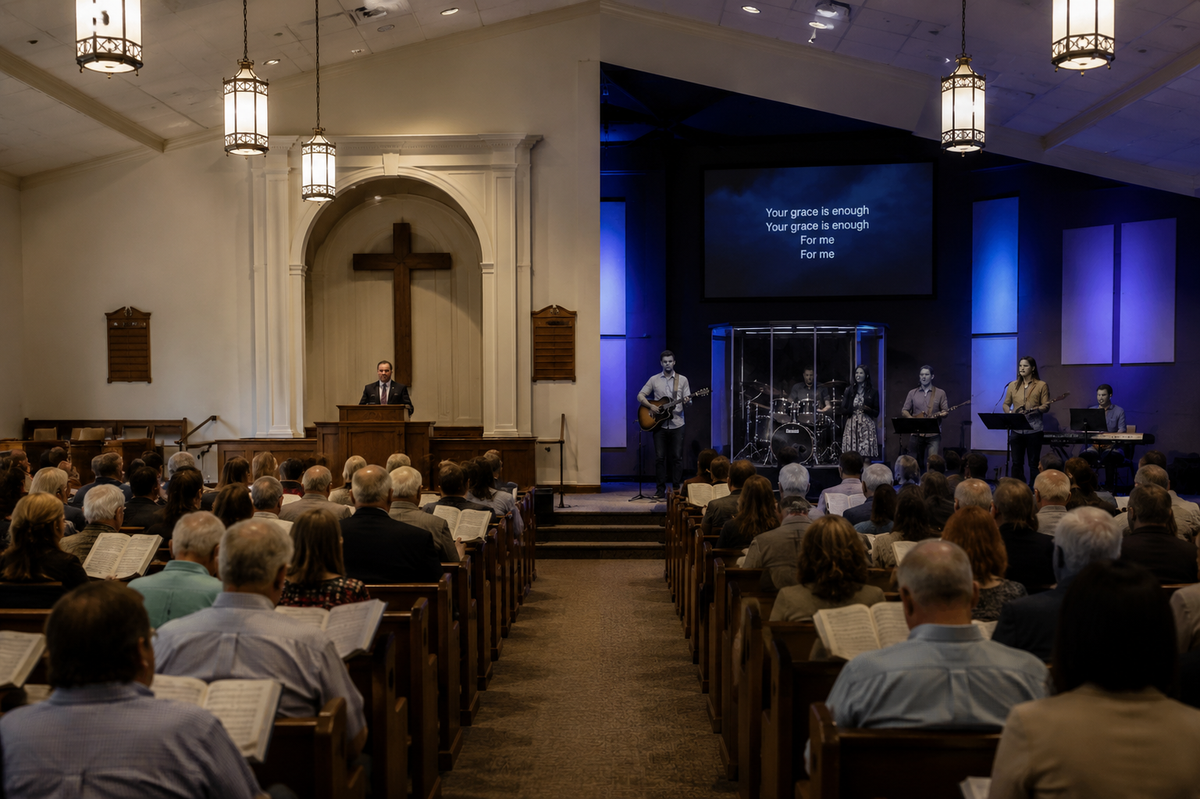
On Sunday mornings at a growing number of Churches of Christ across the United States, worshippers now encounter a choice that would once have been nearly inconceivable within classical Restorationist ecclesiology: one worship service accompanied by instruments, another entirely a cappella. Congregations such as Harpeth Hills Church of Christ publicly advertise both “Instrumental Worship” and “A cappella Worship” within the same congregational structure.
This study is not concerned with assigning moral suspicion to such congregations, nor with questioning the sincerity of those attempting to preserve Christian unity across longstanding disagreement. The more significant issue is intellectual and theological: namely, the extent to which these arrangements reveal an underlying transition in the way ecclesial authority, apostolic silence, and hermeneutical legitimacy are being understood within portions of the Restoration tradition.
This transition becomes particularly visible when congregations begin articulating coexistence itself as a stable ecclesial principle rather than a temporary accommodation. Otter Creek Church, for example, explains that “a cappella and instrumental expressions of worship will continue to be a part of Sunday morning assemblies,” while affirming that its elders “embrace both acappella [sic] and instrumental as acceptable expressions of worship.” The statement is significant not merely because it permits both forms, but because it explicitly institutionalizes their coexistence within the same authorization structure. The issue is no longer whether one practice excludes the other, but whether ecclesial legitimacy itself can remain detached from a singular governing hermeneutic once mutually divergent authorization models are simultaneously normalized.
At first glance, such arrangements appear conciliatory and pragmatic: different worship preferences coexist peacefully within a single ecclesial body. Yet the theological significance of the phenomenon extends far beyond musical style itself. The rise of blended-service congregations reveals a significant and often unacknowledged hermeneutical transition within portions of the Churches of Christ: the gradual displacement of a historically rigorous theory of biblical authorization by a more permissive model of negotiated coexistence.
The observations that follow do not emerge from passing institutional frustration or from a recent encounter with contemporary worship debates. Questions surrounding hermeneutics, apostolic authority, and the interpretive function of silence have formed a substantial part of my scholarly reflection for many years. More specifically, the rise of blended or bifurcated worship structures has repeatedly drawn my attention over the last decade as I have observed a growing number of congregations attempt to preserve institutional unity while accommodating fundamentally divergent theories of ecclesial authorization. What initially appeared to many to be a localized liturgical adjustment now reveals itself, upon closer examination, as a more consequential reconfiguration of Restorationist hermeneutics.
The issue, therefore, is not ultimately whether instruments should accompany Christian worship. Nor is it merely a dispute concerning tradition, aesthetics, or generational preference. The more fundamental question is whether incompatible theories of ecclesial authority can coexist within a single congregational structure without one theory functionally subordinating the other. By “theory,” I do not mean conjecture. I mean the church’s operative account of how Scripture authorizes belief and practice.In this essay, the word theory does not imply conjecture, skepticism, or uncertainty concerning biblical truth. It refers instead to a framework of reasoning — an account of how Scripture authorizes doctrine, worship, and ecclesial practice.
| What “Theory” Does Not Mean | What “Theory” Means |
|---|---|
| Mere speculation | A framework for reasoning from Scripture |
| Doubt concerning biblical truth | An account of how authority functions within the church |
| Relativism or doctrinal indifference | A method for moving from text to ecclesial practice |
| A denial of scriptural authority | A structured account of how commands, examples, inferences, and silence are understood to govern the church |
“The question is not whether we possess a framework, but whether it remains faithful, coherent, and honestly applied.”
Indeed, the Restoration Movement has always operated with an identifiable framework of authorization, even when it preferred the language of “simply following Scripture.” Command, example, necessary inference, and the prohibitive function of silence together constituted not merely isolated interpretive practices, but an integrated hermeneutical structure for determining ecclesial legitimacy. The movement’s distinctive strength lay in its confidence that Scripture furnished not only theological truth, but a sufficiently complete pattern for regulating doctrine, worship, and congregational order.
None of this is to suggest that Restorationist hermeneutics should be treated as self-authenticating or immune from critical examination. The significance of the Restoration Movement lies not merely in the fact that Thomas and Alexander Campbell advanced an interpretive framework, but in the intellectual seriousness with which they engaged some of the most formidable epistemological currents of the modern world. Drawing upon Baconian inductivism, Scottish common-sense realism, and broader Enlightenment concerns regarding rational method and observable evidence, the Campbells attempted to construct a coherent framework through which Scripture might be interpreted, organized, and ecclesially embodied with intellectual consistency.
That achievement deserves careful recognition. The Restorationist project was not an abandonment of hermeneutics in favor of “simply reading the Bible.” On the contrary, it represented an ambitious attempt to articulate a disciplined theory of interpretation capable of preserving both the authority of Scripture and the rational integrity of theological reasoning. The movement’s enduring importance therefore lies not merely in its conclusions, but in its recognition that no reader approaches Scripture without some operative interpretive framework. The decisive question is never whether hermeneutics exists, but whether the governing hermeneutic remains coherent, textually responsible, and honestly applied.
In this respect, Restorationist hermeneutics historically functioned not as a substitute for Scripture, but as a disciplined effort to return to the biblical text itself through coherent principles of interpretation. The Campbells did not advocate a reductionistic “New Testament only” Christianity severed from the broader canonical witness. Rather, they sought to understand the relationship between the covenants, the authority of apostolic teaching, and the shape of ecclesial life through sustained engagement with the whole of Scripture. The strength of the Restorationist impulse lay in the conviction that interpretive method should illuminate the biblical canon rather than compete with it, and that ecclesial practice should arise from disciplined textual engagement rather than from historical inheritance, institutional habit, or purely subjective intuition.
One of the most influential texts historically shaping Restorationist approaches to biblical authorization is Deuteronomy 4:2. The passage became especially significant within hermeneutical systems emphasizing the completeness and sufficiency of divine instruction.
“The question was never merely whether a practice appeared beneficial, but whether the church possessed authority to introduce what Scripture itself had not authorized.”
Historically, Churches of Christ did not oppose instrumental worship primarily on emotional, stylistic, or pragmatic grounds. The objection was fundamentally hermeneutical. Worship practices were understood to require positive apostolic authorization, whether through command, approved example, or necessary inference. Because the New Testament nowhere explicitly authorized instrumental accompaniment within the assembled church, instrumental worship came to be regarded as ecclesiologically improper.
This distinction is critical because classical non-instrumentalism did not ordinarily argue that Scripture explicitly condemned the use of instruments. Rather, the argument depended upon a broader authorization structure in which apostolic silence functioned prohibitively. Once Scripture was treated as a complete regulatory pattern for ecclesial practice, silence could no longer remain hermeneutically neutral. If authorization was understood to be exhaustive, silence necessarily became exclusionary. The coherence of the argument, therefore, rested not upon an isolated prooftext but upon the internal coherence of the larger interpretive system itself.
The instrumental controversy historically depended less upon explicit condemnation than upon differing understandings of how apostolic silence functions within ecclesial authorization.
| Silence as Non-Prohibitive | Silence as Prohibitive |
|---|---|
| Absence does not necessarily prohibit | Absence restricts authorization |
| Liberty emphasized where Scripture is silent | Positive warrant required for ecclesial practice |
| Practices may remain permissible absent condemnation | Practices become excluded absent authorization |
“The entire instrumental controversy ultimately depends upon which theory of silence governs the authorization structure.”
This logic did not emerge arbitrarily. It developed within a broader nineteenth-century Restorationist effort shaped by Baconian inductivism, Scottish common-sense realism, and a sustained effort to restore primitive Christianity through reproducible apostolic forms. The governing interpretive question gradually shifted from “What does this text mean?” to include “What practices does this text authorize?” Within such a framework, interpretation became increasingly procedural as the hermeneutical center of gravity shifted from theological meaning toward ecclesial authorization. Silence, accordingly, ceased to function merely as textual absence and came instead to operate as a juridical boundary.
The implications of that development proved far-reaching. Once apostolic silence came to function as a prohibitive norm within the authorization structure, the church no longer approached worship practices principally through broad theological reasoning or historical continuity, but through questions of positive warrant. The decisive issue became not whether a practice appeared spiritually beneficial, aesthetically compelling, or historically familiar, but whether the church possessed sufficient apostolic authorization to enact it.
Within that system, instrumental worship represented not merely an alternative liturgical preference but an unauthorized innovation. The coherence of the contemporary blended-service model, therefore, depends almost entirely upon whether this earlier authorization logic remains binding. If silence continues to function prohibitively, the coexistence of instrumental and non-instrumental worship within the same ecclesial structure becomes difficult to reconcile. If, however, silence no longer operates prohibitively in the classical Restorationist sense, then the movement’s governing hermeneutic has already undergone a significant transformation, whether or not that transformation has been fully acknowledged.
At precisely this point, the apparent symmetry of the blended arrangement begins to dissolve. What initially presents itself as a pragmatic accommodation of differing worship preferences gradually reveals a structural asymmetry embedded in the underlying authorization structures themselves. The permissive position can ordinarily accommodate both forms of worship without internal contradiction. The classical non-instrumental position, however, cannot do so without significant theological strain, because the very logic that historically excluded instrumental worship simultaneously renders ecclesial sponsorship of such worship theologically problematic. The issue, therefore, is not merely coexistence, but whether two fundamentally different understandings of apostolic authority can remain institutionally joined without one framework quietly displacing the other.
The blended-service model initially appears symmetrical: two worship forms peacefully coexisting within one congregation. Yet the underlying authorization structures do not bear the arrangement equally.
| Permissive Position | Classical Non-Instrumental Position |
|---|---|
| Instrumental worship regarded as permissible | Instrumental worship regarded as lacking apostolic authorization |
| A cappella worship remains fully legitimate | Eldership sponsors what it simultaneously regards as problematic |
| Diversity of worship forms creates no structural contradiction | Liturgical coexistence generates theological strain |
| Coexistence remains hermeneutically coherent | Authorization structure becomes internally uneven |
For the permissive position, coexistence presents little internal difficulty. If instrumental worship is understood to fall within the sphere of legitimate Christian liberty, then a cappella worship remains equally legitimate. The permissive framework, therefore, accommodates diversity of form without substantial theological strain. An a cappella assembly may be retained as a matter of tradition, pastoral sensitivity, spiritual preference, or historical continuity while the underlying authorization structure remains fundamentally intact.
For the classical non-instrumental position, however, the situation is considerably more complex. If instrumental worship lacks apostolic authorization, then an eldership formally sponsoring such worship assumes responsibility for institutionalizing a practice it simultaneously regards as lacking sufficient New Testament warrant. The resulting tension is not merely practical but hermeneutical. The congregation comes to inhabit two incompatible judgments at once: instrumental worship is sufficiently problematic to necessitate liturgical separation, yet sufficiently permissible to receive formal ecclesial sponsorship and organizational protection.
Here the asymmetry becomes decisive. The blended model does not preserve both positions equally. The permissive hermeneutical structure remains structurally intact because its underlying theory of authorization already possesses the elasticity necessary to accommodate multiple worship forms. The classical non-instrumental position, by contrast, undergoes a far more substantial conceptual relocation. What had historically been articulated as a question of divine authorization gradually becomes reframed as a matter of congregational preference, historical identity, or liturgical tradition. The decisive transformation occurs not when the practice itself changes, but when the category by which the practice is judged changes.
This transition becomes especially visible in recent journalistic treatments of blended congregations. In reporting on the merger between the Sunrise and Northside Churches of Christ in Spokane, Washington, The Christian Chronicle described the newly unified congregation’s movement toward blended worship despite longstanding disagreement concerning instrumental music. Particularly revealing was the article’s explanation that certain doctrines previously regarded by Northside leadership as “vital” had come to be viewed instead as “traditions.”
That seemingly modest linguistic shift signals a substantial hermeneutical relocation. Historically, instrumental worship was not ordinarily classified within Churches of Christ as a negotiable tradition analogous to local custom or aesthetic preference. It was understood instead as an ecclesiological question concerning apostolic authorization and the limits of ecclesial authority. The controversy, therefore, was never fundamentally reducible to musical taste. At stake was the nature of biblical warrant itself and the degree to which congregational practice remained governed by a binding theory of authorization rooted in the perceived completeness of the New Testament pattern.
What makes the Chronicle’s framing noteworthy is not merely the reporting of institutional change, but the categories through which that change is interpreted and morally narrated. Throughout the article, the rationale repeatedly shifts away from juridical authorization and toward mission, institutional sustainability, coexistence, demographic decline, and evangelistic effectiveness. The Pacific Northwest is described as “a mission field,” while congregations are said no longer to possess “the luxury of clinging to traditions that hinder their ability to evangelize.” Such language is revealing not merely sociologically, but hermeneutically. Resistance to blended worship is subtly relocated from the category of theological conviction to that of institutional inflexibility or missional limitation.
That transition is more consequential than it first appears. Earlier generations within Churches of Christ framed the instrumental controversy principally as a question of ecclesial fidelity and apostolic authorization. Increasingly, however, the dispute is recast as a test of relational openness, congregational harmony, and institutional cooperation. Particularly revealing in this respect was elder Steve Payne’s summary of the congregation’s newer posture: “Get over your differences — we’re about Jesus.”
The statement is significant not because it lacks sincerity, but because it quietly alters the governing moral grammar of the controversy itself. Historically, the central question concerned whether the church possessed divine authority for a given practice. Within the emerging framework, however, the greater moral danger becomes division rather than unauthorized innovation. The governing concern shifts from authorization toward coexistence, from juridical legitimacy toward relational continuity. The decisive transformation occurs not simply when practices change, but when the categories by which those practices are morally evaluated are themselves redefined.
This transition also reshapes the function of preaching. Within tightly regulated hermeneutical systems, preaching can gradually cease to operate primarily as κήρυγμα (kērygma), “public proclamation” of the gospel addressed to a contested world (1 Cor 1:21, NA28), and instead function predominantly as confirmatio, the classical rhetorical practice of reinforcing conclusions already accepted by one’s audience. Because the congregation already shares the underlying authorization structure, sermons increasingly reinforce conclusions already secured within that framework rather than exposing those conclusions to sustained hermeneutical examination or public apologetic engagement.
The movement from proclamation toward reinforcement is subtle but significant. Apostolic preaching in the New Testament repeatedly appears within contexts of dispute, persuasion, apologetic encounter, and interpretive contestation. Paul reasons publicly in synagogues and marketplaces (Acts 17:17, NA28), defends the faith before rulers and philosophers (Acts 24–26), and presents Christian witness in forms directed toward the open civic world rather than inward ecclesial reassurance alone. Likewise, Peter frames Christian witness in explicitly apologetic terms, exhorting believers to be “always prepared to make a defense” — ἀπολογία (apologia), a “reasoned defense” or formal answer — to anyone who asks concerning the hope within them (1 Pet 3:15, NA28).
By contrast, preaching shaped principally by boundary maintenance and intramural authorization disputes risks becoming internally recursive: a rhetoric of reassurance directed toward those already formed by the same inferential assumptions. Under such conditions, the sermon no longer functions primarily as public proclamation in the apostolic sense, but as the liturgical reinforcement of an inherited epistemic framework. The church continues to speak with confidence, though within a closed interpretive environment in which the guiding assumptions themselves rarely encounter serious external interrogation.
This development helps explain why the blended-service model is not merely liturgical but institutional. It represents a form of ecclesial decoupling in which inherited rhetoric remains formally intact while operative assumptions evolve beneath the surface. Churches continue to speak the language of Restorationist certainty while increasingly functioning according to pluralistic models of negotiated coexistence. The older hermeneutic survives rhetorically and devotionally, but structurally it no longer regulates the system in the same way.
These observations are not offered in a spirit of ecclesial antagonism, but from a conviction that the church is best served by careful theological and hermeneutical clarity pursued under the authority of Scripture itself. The New Testament exhorts believers to “love the brotherhood” (1 Pet. 2:17), and genuine love for the church does not relieve Christians of the responsibility to examine the interpretive frameworks shaping ecclesial faith and practice. If such frameworks influence the moral and theological structure of congregational life, then they warrant open, careful, and intellectually honest examination in the light of the biblical text.
What is being altered, therefore, is not merely a liturgical practice, but the load-bearing architecture of the Restorationist theory of ecclesial authority itself. Once silence ceases to function prohibitively in one domain while remaining rhetorically authoritative in others, the system’s internal coherence begins to redistribute unevenly. The language of apostolic authorization survives, but its regulative function becomes selective, negotiated, and institutionally mediated. What emerges is not the abrupt abandonment of Restorationist logic, but a gradual shift in the movement’s hermeneutical center of gravity away from juridical authorization and toward a model of ecclesial coexistence sustained less by shared hermeneutical certainty than by institutional negotiation.
The transition occurring within portions of the Churches of Christ is not always explicit. More often, the governing assumptions gradually relocate from one organizing center toward another.
“The transition is not always explicit, but operational.”
Philology further complicates these older certainty structures. Debates concerning instrumental worship have frequently been reduced to lexical disputes surrounding ψάλλω (psallō; Eph 5:19, NA28), commonly glossed “to sing,” “make melody,” or historically “to pluck.” Significantly, Ephesians 5:19 distinguishes between ᾄδοντες (“singing”) and ψάλλοντες (psallontes), suggesting a distinction in verbal expression rather than strict synonymy within the participial pair. Yet the underlying issue has never been merely the semantic range of a single Greek term. The more fundamental question concerns the degree of interpretive certainty required by a prohibitive hermeneutic. Once ecclesial legitimacy depends upon exhaustive authorization, ordinary semantic complexity itself becomes institutionally destabilizing.
The semantic history of ψάλλω itself illustrates the problem. Across Septuagintal and broader Hellenistic Greek usage, the term exhibits layered and historically conditioned meaning. Within the Septuagint especially, ψάλλω appears in explicitly instrumental contexts, as in Ps 32[33]:2 LXX, where the imperative ψάλατε occurs with ἐν ψαλτηρίῳ δεκαχόρδῳ, “with a ten-stringed psaltery,” and Ps 97[98]:5 LXX, where ψάλατε τῷ κυρίῳ occurs with ἐν κιθάρᾳ, “with the lyre.” This observation does not “prove” the legitimacy of instrumental worship within Christian assembly. It does, however, demonstrate that the semantic and canonical world inherited by early Christians was far more liturgically textured than later Restorationist reductions sometimes allowed.
More significantly, the New Testament itself rarely handles Old Testament worship categories through mechanically procedural replication. The Epistle to the Hebrews approaches temple worship typologically and christologically rather than as a blueprint for direct liturgical transfer. The sacrificial system is interpreted through fulfillment, transformation, and eschatological completion, not through juridical reproduction. In this respect, the canon operates theologically rather than procedurally. That reality places substantial pressure upon any authorization structure requiring exhaustive procedural certainty in order to sustain ecclesial legitimacy.
Ultimately, the emergence of blended-service congregations reveals a more substantial transformation already underway within portions of the Churches of Christ. Once coexistence becomes institutionally normative, silence no longer functions prohibitively in the classical Restorationist sense. The older logic may survive rhetorically, devotionally, and through inherited ecclesial continuity, but operationally its governing authority has already begun to recede. A principle selectively suspended ceases, over time, to function as a principle in the same exhaustive manner.
The central question now confronting contemporary Churches of Christ is therefore no longer merely whether instruments may accompany worship. The more difficult question is whether a movement historically organized around a tightly regulated theory of biblical authorization can fully acknowledge how profoundly its operative hermeneutic has changed. The blended-service congregation thus represents not merely a compromise in worship style, but a transitional ecclesial form: one that preserves the language of Restorationist certainty while increasingly operating according to a theology of negotiated coexistence.