New Testament Christianity and the Interpretive Crisis of Restorationism



This essay was written by Shawn D. Mathis, PhD, MSc (Oxon), MA, who serves as an elder at the Nashville Church of Christ. His work focuses on theology, hermeneutics, philosophy of language, and questions of scriptural authority within the Restoration heritage.
What increasingly emerges beneath many contemporary ecclesial tensions is not merely disagreement over isolated doctrinal conclusions, but the cumulative strain produced by a rapidly fragmenting interpretive environment. Congregations now confront a convergence of political fragmentation, digital media saturation, contested moral anthropology, collapsing institutional trust, and competing accounts of moral legitimacy.
Earlier Restorationist assumptions emerged within comparatively stable moral and intellectual conditions shaped by confidence in common-sense reasoning and coherent interpretive conclusions. The interpretive burdens now placed upon ministers, elders, and congregational leadership frequently extend far beyond the traditional scope of sermon preparation or local pastoral administration.
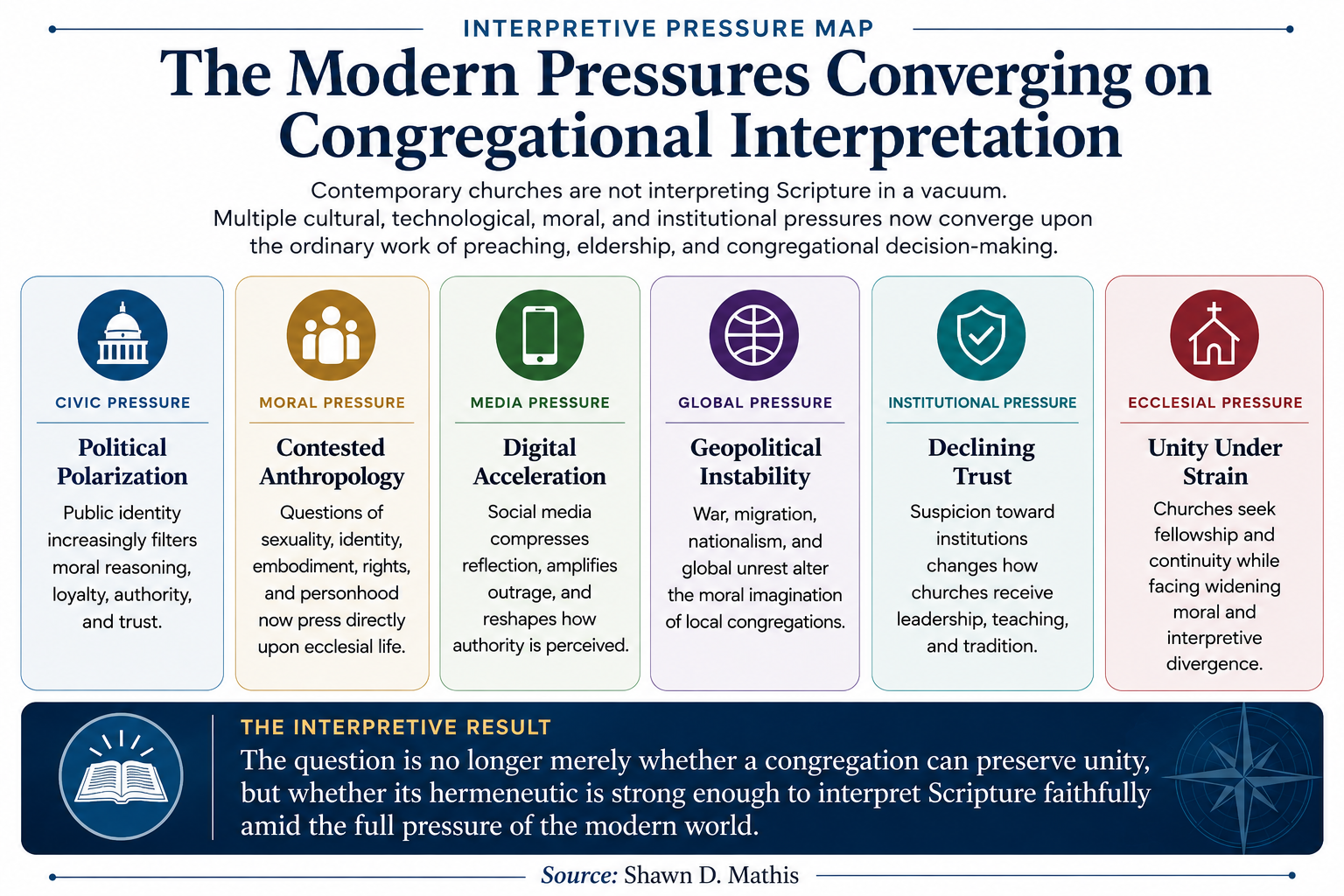
Coexistence models become institutionally understandable even where they remain hermeneutically unresolved. As interpretive pressures intensify, churches frequently seek mechanisms capable of preserving relational continuity amid widening theological, cultural, and political divergence.
More fundamentally, the issue concerns whether the inherited hermeneutical structures of the American Restoration Movement — developed within a nineteenth-century intellectual environment shaped by Baconian induction, Scottish Common Sense Realism, and confidence in the essential transparency of the biblical text — remain fully capable of sustaining the interpretive pressures confronting the contemporary church.
This question should not be mistaken for hostility toward Restorationist thought itself. On the contrary, the Restoration heritage emerged from a deeply serious attempt to submit ecclesial life to disciplined biblical reasoning rather than inherited ecclesiastical hierarchy, sectarian creedalism, or merely traditional authority. Thomas and Alexander Campbell did not seek interpretive chaos, but interpretive accountability.
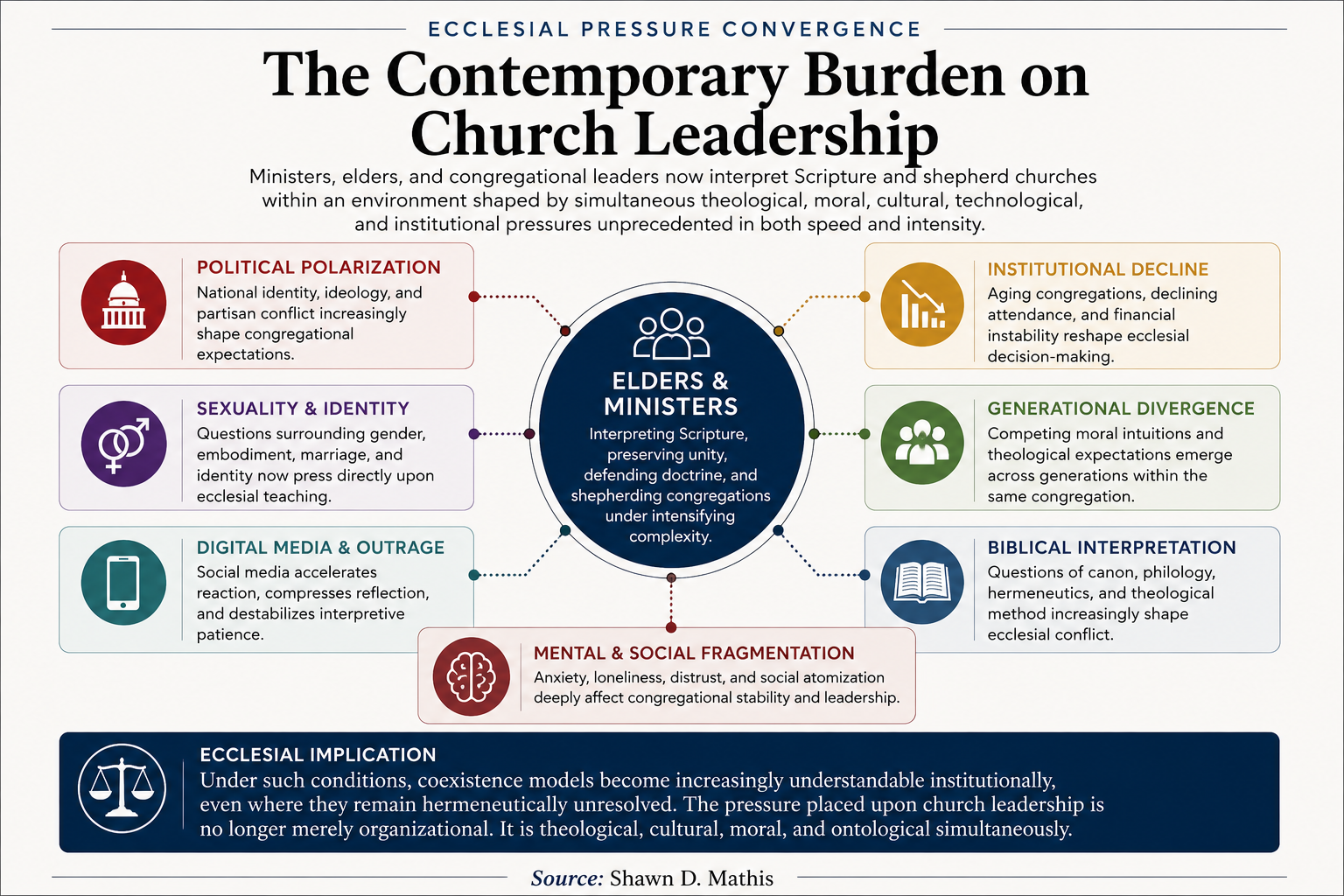
Within the Churches of Christ, these interpretive responsibilities do not exist abstractly. They fall concretely upon local preachers, congregational elders, Bible professors, theological educators, and the institutions responsible for forming future ministers and church leaders. These individuals function as primary interpretive stewards of the movement’s theological future. They bear moral, spiritual, and intellectual responsibility to teach sound doctrine faithfully and form Christian communities capable of living truthfully within the modern world.
That tension becomes especially visible wherever juridical models of authorization encounter the semantic and canonical depth of the biblical text itself. Language does not function mechanically. Greek terminology develops historically, and canonical theology unfolds through typology, intertextuality, and covenantal development rather than purely procedural replication. The Epistle to the Hebrews, for example, approaches temple worship christologically and typologically rather than as a blueprint for direct liturgical reproduction. As Paul writes, καθὼς καὶ ἐν πάσῃ σοφίᾳ λαλοῦμεν (“which things we also speak in words taught by wisdom,” 1 Cor. 2:13, NA28).
Deuteronomy itself warns: οὐ προσθήσετε πρὸς τὸ ῥῆμα … καὶ οὐδὲ μὴ ἀφέλητε ἀπ’ αὐτοῦ (“You shall not add to the word … nor take away from it,” Deut. 4:2, Rahlfs LXX). The contemporary question, however, is not whether fidelity to Scripture matters, but how such fidelity is to be understood within the larger theological and christological movement of the canon itself.
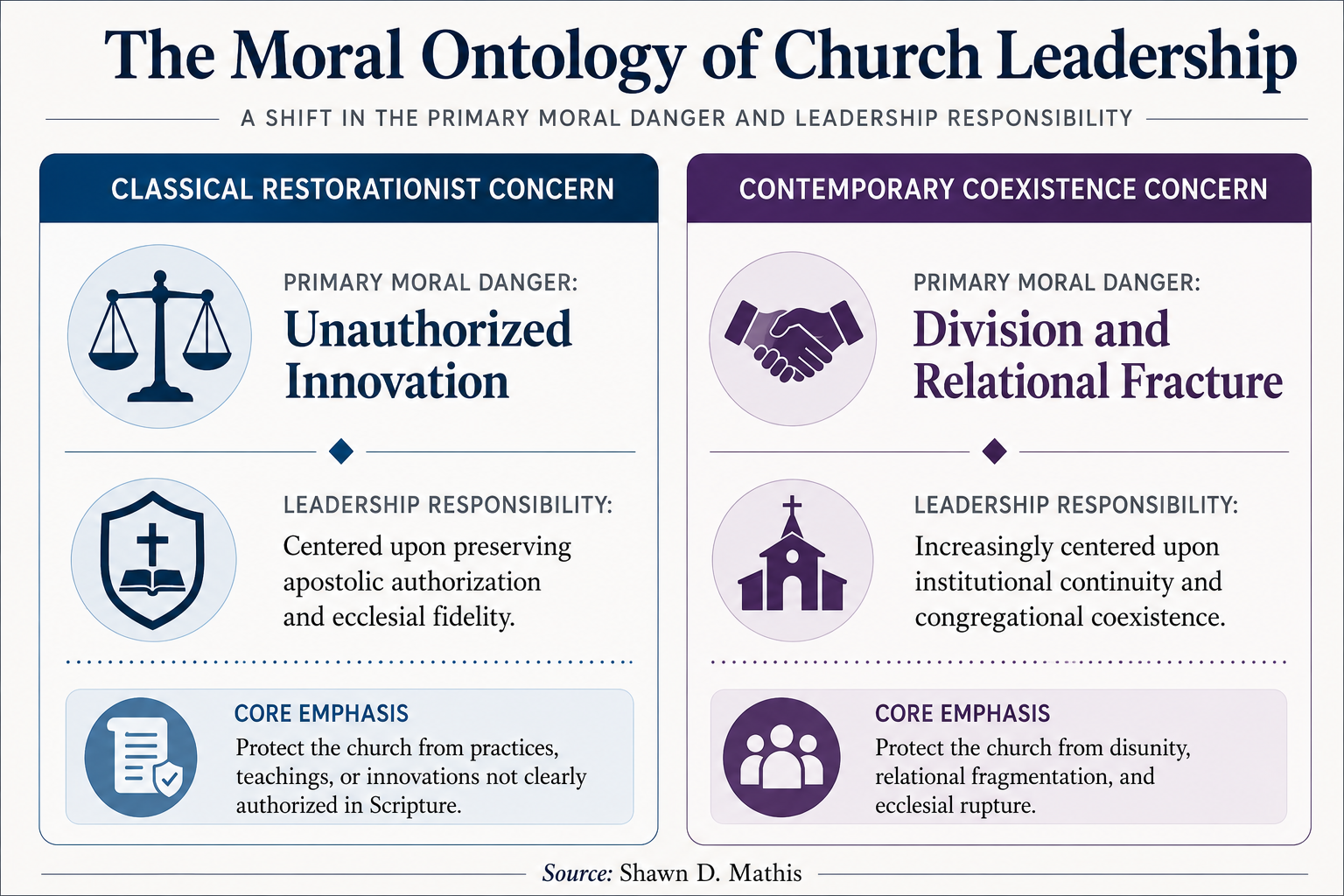
Nor does the challenge arise solely from philology or biblical theology. It also emerges from moral ontology itself — from competing understandings of what church leaders believe themselves morally responsible to preserve. Within classical Restorationist logic, the central danger often concerned unauthorized innovation and the failure to remain faithful to the authority of the apostolic witness. That concern should not be dismissed lightly, nor should contemporary cultural pressures be permitted to dissolve the church’s obligation to faithful biblical interpretation and doctrinal seriousness.
The challenge concerns how the Restoration commitment to biblical authority and apostolic Christianity can be sustained faithfully within conditions of increasing interpretive and cultural complexity. Fresh, Scripture-guided theological reflection is therefore required if the church is to maintain its integrity, sustain its witness, and continue growing faithfully within the modern world.
One of the great strengths of the American Restoration Movement was its refusal to treat ecclesial tradition, institutional hierarchy, or denominational identity as self-authenticating. At its best, the movement insisted that the church remained accountable to Scripture and that theological claims required principled interpretive justification rather than mere historical repetition.
First, the movement recognized that hermeneutics matters. In this respect, Restorationism rightly resisted both individualistic subjectivism and unexamined ecclesiastical traditionalism. The insistence that the church must continually return ad fontes — back to the sources — remains one of the movement’s enduring intellectual virtues.
Second, Restorationism, properly understood, holds that doctrine and practice cannot be separated from questions of authority. Against the tendency to reduce theological disputes to preference or institutional pragmatism, the movement insisted that worship, polity, and doctrine all involved claims concerning apostolic legitimacy.
Third, the movement’s emphasis upon canonical seriousness should be preserved. The Restoration impulse toward sustained textual engagement provided an important corrective to doctrinal indifference and shallow ecclesiastical traditionalism.
The challenge facing contemporary Churches of Christ may therefore involve not the abandonment of Restorationist hermeneutics, but its theological deepening while remaining fully accountable to Scripture and the apostolic witness.
In some respects, it may represent continuity with the Restoration Movement’s deepest intellectual instinct: the willingness to reexamine inherited assumptions in the light of Scripture itself. The Campbells were attempting to create a disciplined method by which the church could remain accountable to the biblical canon rather than to inherited human systems.
Within portions of the Restoration movement, adherents' confidence in biblical inspiration occasionally became intertwined with confidence in a particular interpretive mechanism for extracting ecclesial certainty from the text. Over time, challenges to the interpretive framework could feel indistinguishable from challenges to Scripture itself. Yet these are not identical questions.
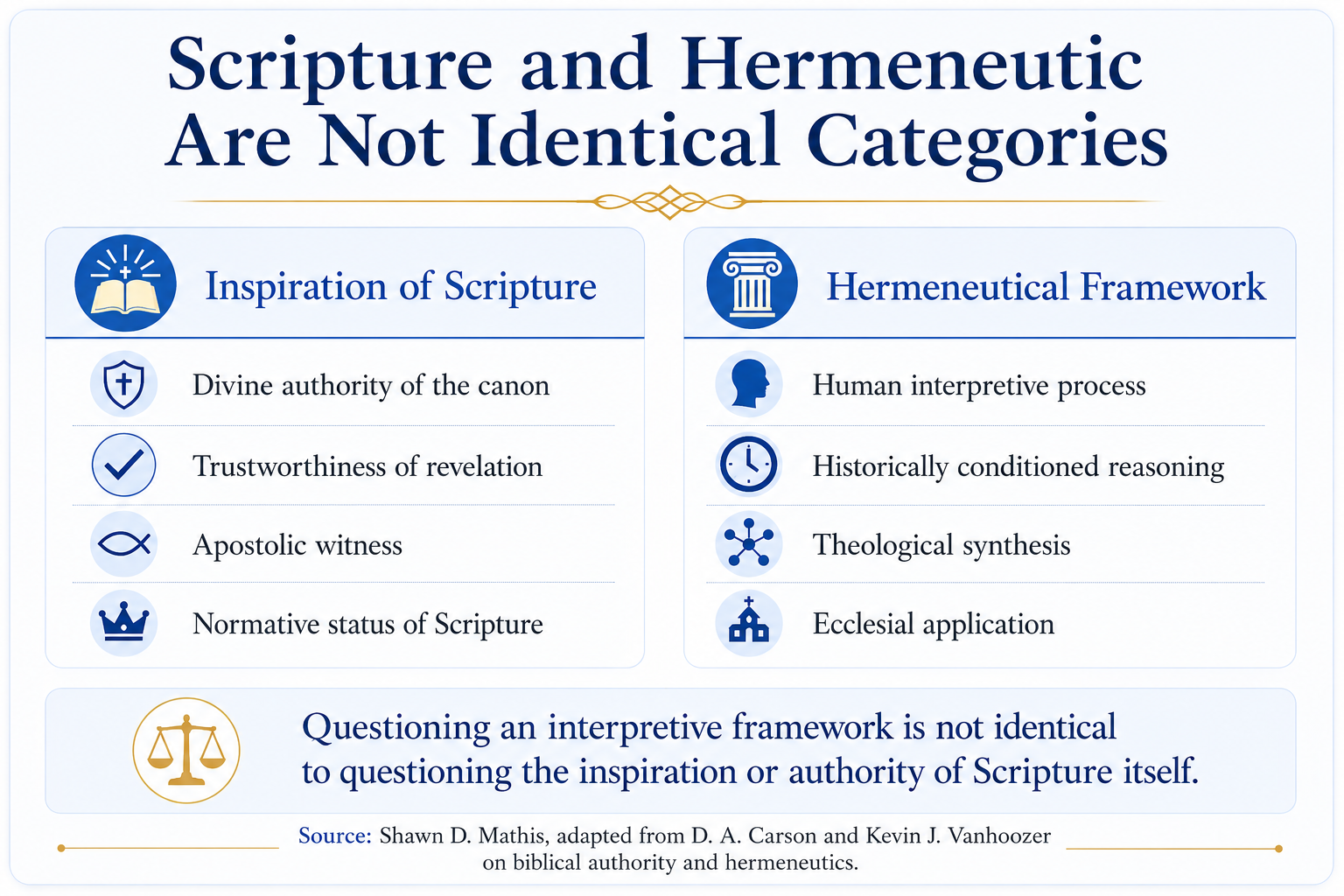
The inspiration of Scripture concerns the divine authority and trustworthiness of the biblical canon. Hermeneutics concerns the historically conditioned processes through which human communities interpret, synthesize, and apply that canon within ecclesial life.
Confusing those categories can produce significant theological instability. If every tension within an inherited interpretive model is treated as a threat to inspiration itself, the church may become unable to reexamine its own hermeneutical assumptions without experiencing the process as doctrinal collapse.
A more stable theological posture may require distinguishing carefully between confidence in Scripture and confidence in particular historically developed theories of authorization. The church’s recognition that interpretive frameworks remain historically situated does not require surrendering belief in divine revelation. Indeed, Scripture itself repeatedly demonstrates awareness of interpretive depth, canonical development, typology, semantic layering, and theological recapitulation. The biblical canon does not behave as though meaning is always mechanically self-evident or reducible to procedural extraction. Rather, the canon frequently invites sustained meditation, theological synthesis, covenantal reflection, and interpretive maturity. Peter himself acknowledges this complexity when describing portions of Paul’s writings as δυσνόητά τινα (“some things hard to understand,” 2 Pet. 3:16, NA28). Hermeneutical depth is not necessarily a modern imposition upon Scripture. In important respects, it is already recognized within the canon itself.
The Epistle to the Hebrews offers perhaps the clearest example. Hebrews treats earlier biblical institutions not as discarded falsehoods, but as typological anticipations fulfilled and transformed within the larger christological movement of redemptive history.
Acknowledging semantic elasticity, historical context, canonical development, or hermeneutical complexity does not weaken inspiration. It may instead require a more intellectually and theologically robust doctrine of inspiration — one capable of accounting for the full richness of the canon rather than reducing biblical authority to a narrowly procedural authorization system.
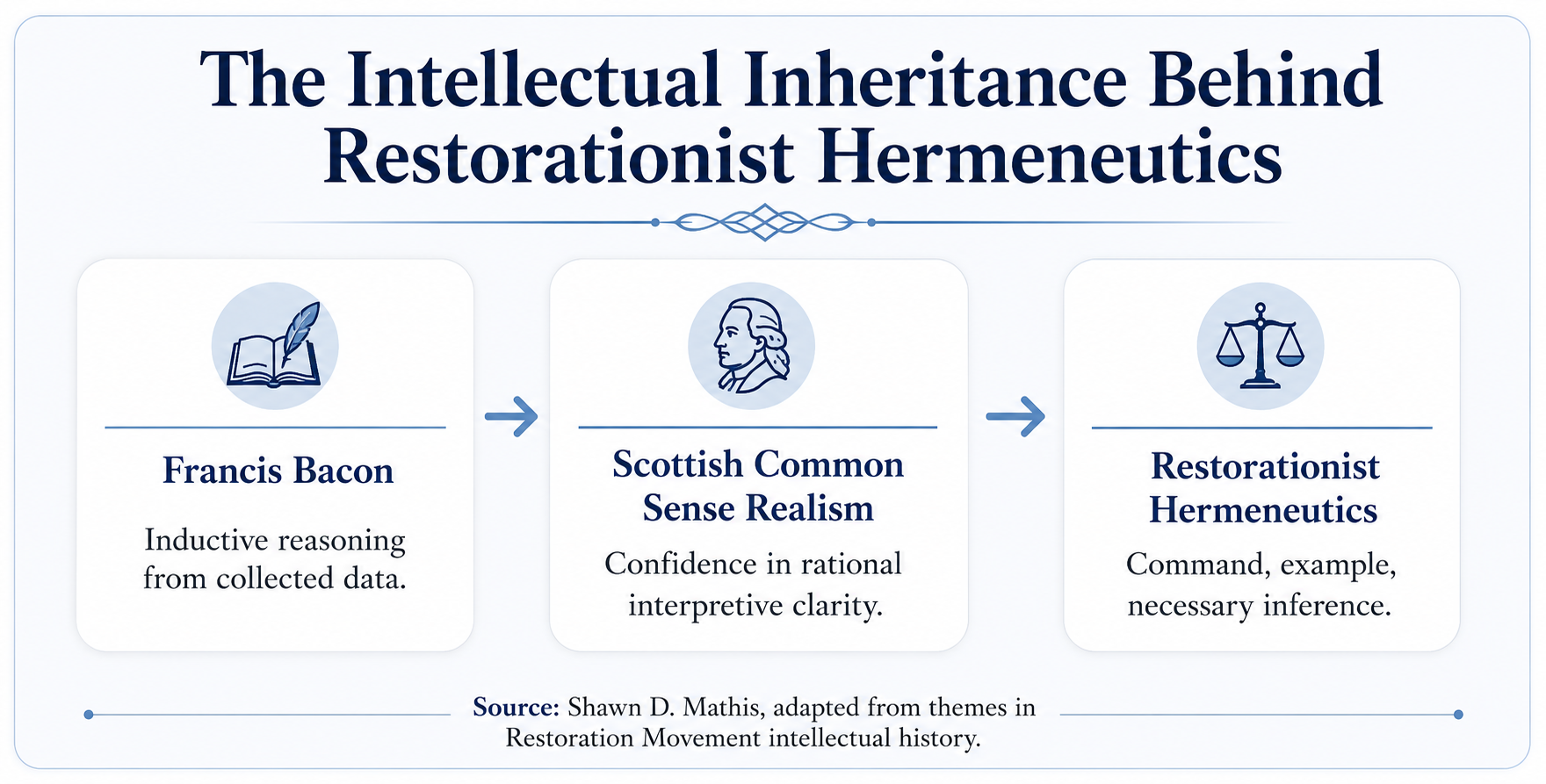
The Campbells remained deeply committed to the divine authority of Scripture. Yet they also operated within an intellectual environment shaped by Enlightenment confidence that disciplined reasoning, careful observation, and properly ordered method could yield stable and reproducible conclusions.
Baconian induction and Scottish Common Sense Realism reinforced confidence that disciplined reasoning could produce stable interpretive conclusions from Scripture. These intellectual currents encouraged the belief that rational observers, approaching a text honestly and methodically, could arrive at substantially similar conclusions concerning meaning and reality. Scripture could therefore function almost constitutionally: as a sufficiently transparent body of authoritative data capable of producing coherent ecclesial order through disciplined interpretive method.
However, Enlightenment assumptions also shaped expectations concerning textual transparency, procedural certainty, interpretive reproducibility, and the relationship between facts and conclusions. The biblical canon increasingly came to be approached as though sufficiently disciplined interpretive method could reliably generate stable ecclesial certainty across nearly all major questions of doctrine and practice.
Modern interpretive conditions have become far less stable than the intellectual environment within which those assumptions originally developed. Historical criticism, philology, semantic theory, canonical theology, media fragmentation, postmodern epistemological skepticism, contested moral anthropology, and accelerating cultural pluralism have all complicated earlier confidence in purely procedural models of interpretive certainty.
The contemporary challenge may not be whether Restorationist hermeneutics should be discarded, but whether it requires theological expansion beyond some of its earlier Enlightenment assumptions concerning rational transparency, procedural certainty, and inferential uniformity. The church may retain the Restoration commitment to biblical authority while developing a more historically conscious and canonically robust account of how Scripture functions within ecclesial life.
Once Scripture is understood as more than procedural authorization alone, the central theological realities of the canon begin to reassert themselves with greater force: creation, covenant, incarnation, resurrection, kingdom, new creation, ecclesiology, moral ontology, and participation in Christ.
Philology reminds the church that language is historically conditioned, while canonical interpretation reminds the church that Scripture functions as a unified theological drama rather than merely isolated authorization units. Paul writes that πᾶσα γραφὴ θεόπνευστος (“all Scripture is God-breathed,” 2 Tim. 3:16, NA28), yet the canon itself requires theological discernment concerning how its diverse witnesses cohere within redemption.
The New Testament repeatedly presents the resurrection as the inauguration of new creation, the vindication of Christ’s lordship, the defeat of death, the beginning of eschatological renewal, and the reconstitution of human existence under the reign of God. Paul’s theology cannot be reduced to procedural authorization categories alone. His ecclesiology emerges from participation in Christ, incorporation into the resurrected body, covenantal fulfillment, pneumatology, and eschatological transformation. Writing to the Corinthians, Paul describes the church as κοινωνία … τοῦ υἱοῦ αὐτοῦ Ἰησοῦ Χριστοῦ (“participation in his Son Jesus Christ,” 1 Cor. 1:9, NA28). The church is not merely a correctly regulated institution, but a people drawn into communion with the crucified and risen Lord.
Paul’s resurrection theology repeatedly frames the church within the horizon of new creation itself. As he writes elsewhere, εἴ τις ἐν Χριστῷ, καινὴ κτίσις (“if anyone is in Christ — new creation,” 2 Cor. 5:17, NA28). The church exists not merely as a correctly ordered institution — though such order remains important and biblically accountable — but as a people already participating in the inaugurated realities of the age to come.
Once this larger canonical and theological horizon becomes visible, the limitations of overly procedural hermeneutical systems also become more apparent.
Ecclesial reasoning may require a thicker theological account of Scripture than some historically developed Restorationist formulations were prepared to sustain.
The fundamental issue concerns whether the church’s hermeneutic is sufficiently capacious to sustain the theological reality proclaimed by the canon itself: that in the resurrection of Jesus Christ, a new creation has already entered history, and the church exists not merely as an authorized institution, but as a people being transformed into participation within that reality.
The Restoration Movement was never fundamentally attempting to create novelty, theological experimentation, or ecclesial relativism. At its deepest level, the movement was animated by a profound desire to recover New Testament Christianity, the apostolic church, and the ecclesial reality for which Christ died. That impulse should be treated with seriousness and respect.
The difficulty arose when the restoration of “New Testament Christianity” gradually became compressed into an increasingly procedural and juridical system for determining ecclesial legitimacy. Over time, the distinction between recovering the theological reality of the apostolic church and reproducing an exhaustive procedural blueprint began to narrow.
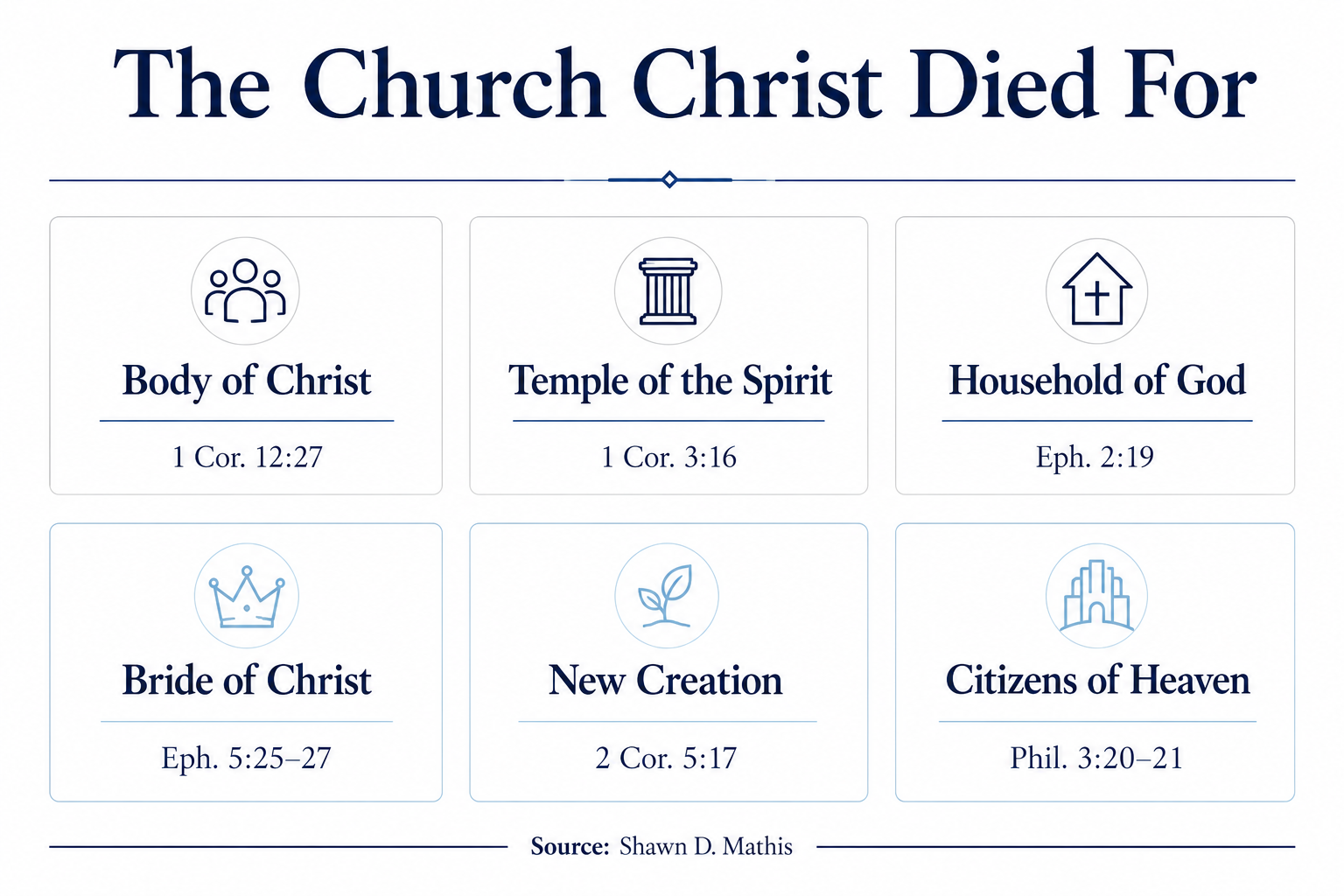
Yet the New Testament itself presents the church in far richer theological categories. Paul describes the church as σῶμα Χριστοῦ (“the body of Christ,” 1 Cor. 12:27, NA28), while elsewhere the church becomes ναὸς θεοῦ (“the temple of God,” 1 Cor. 3:16, NA28), οἰκεῖοι τοῦ θεοῦ (“the household of God,” Eph. 2:19, NA28), and the bride for whom Christ gave himself in covenantal love (Eph. 5:25–27, NA28). The apostolic witness frames the church within the horizon of new creation itself: εἴ τις ἐν Χριστῷ, καινὴ κτίσις (“if anyone is in Christ — new creation,” 2 Cor. 5:17, NA28). The church emerges in the New Testament not merely as a by-the-book ordered institution, but as an eschatological people constituted through the death, resurrection, and lordship of Jesus Christ.
Ecclesiology cannot be reduced merely to procedural authorization questions, however important those questions remain. The church is not simply a juridically regulated institution. It is a redeemed and resurrected people participating in the life of Christ through the Spirit under the authority of the canon.
This is precisely why the contemporary hermeneutical question becomes so consequential. The issue is not whether biblical authority matters — it unquestionably does. Nor is the issue whether ecclesial practices require theological accountability — they plainly do.
The New Testament repeatedly grounds ecclesial identity not merely in procedural continuity, but in union with the crucified and risen Christ himself. Paul writes that Christ is ἡ κεφαλὴ τοῦ σώματος τῆς ἐκκλησίας (“the head of the body, the church,” Col. 1:18, NA28).
The question instead concerns whether historically developed forms of Restorationist hermeneutics remain sufficient to sustain the theological and canonical depth of the biblical witness under contemporary interpretive conditions. The aim of this inquiry is not the abandonment of Restorationism, but the preservation of its deepest theological impulse: fidelity to Christ through faithful submission to Scripture rightly interpreted.
Even Paul acknowledges the partial character of present understanding. Writing to the Corinthians, he observes: βλέπομεν γὰρ ἄρτι δι’ ἐσόπτρου ἐν αἰνίγματι (“for now we see through a mirror dimly,” 1 Cor. 13:12, NA28). Hermeneutical humility need not imply theological relativism. Those entrusted with teaching the church remain accountable for rightly handling the biblical text while recognizing the interpretive limits through which human understanding encounters the canon.
The desire for ecclesial unity underlying many contemporary coexistence models should not be dismissed lightly. Scripture repeatedly calls the church toward love, patience, mutual forbearance, and what Paul describes as σπουδάζοντες τηρεῖν τὴν ἑνότητα τοῦ πνεύματος ἐν τῷ συνδέσμῳ τῆς εἰρήνης (“being diligent to preserve the unity of the Spirit in the bond of peace,” Eph. 4:3, NA28). In an age marked by political fragmentation, cultural hostility, institutional distrust, and widening moral division, the longing to preserve congregational continuity and relational fellowship is both understandable and, in many respects, deeply Christian.
Yet Paul’s language in Ephesians is especially important because the same passage immediately grounds ecclesial unity within shared theological realities: ἓν σῶμα καὶ ἓν πνεῦμα … εἷς κύριος, μία πίστις, ἓν βάπτισμα (“one body and one Spirit … one Lord, one faith, one baptism,” Eph. 4:4–5, NA28). Unity in the New Testament is neither merely institutional nor merely emotional. It is theological, ecclesial, and participatory — rooted ultimately in shared participation in Christ himself.
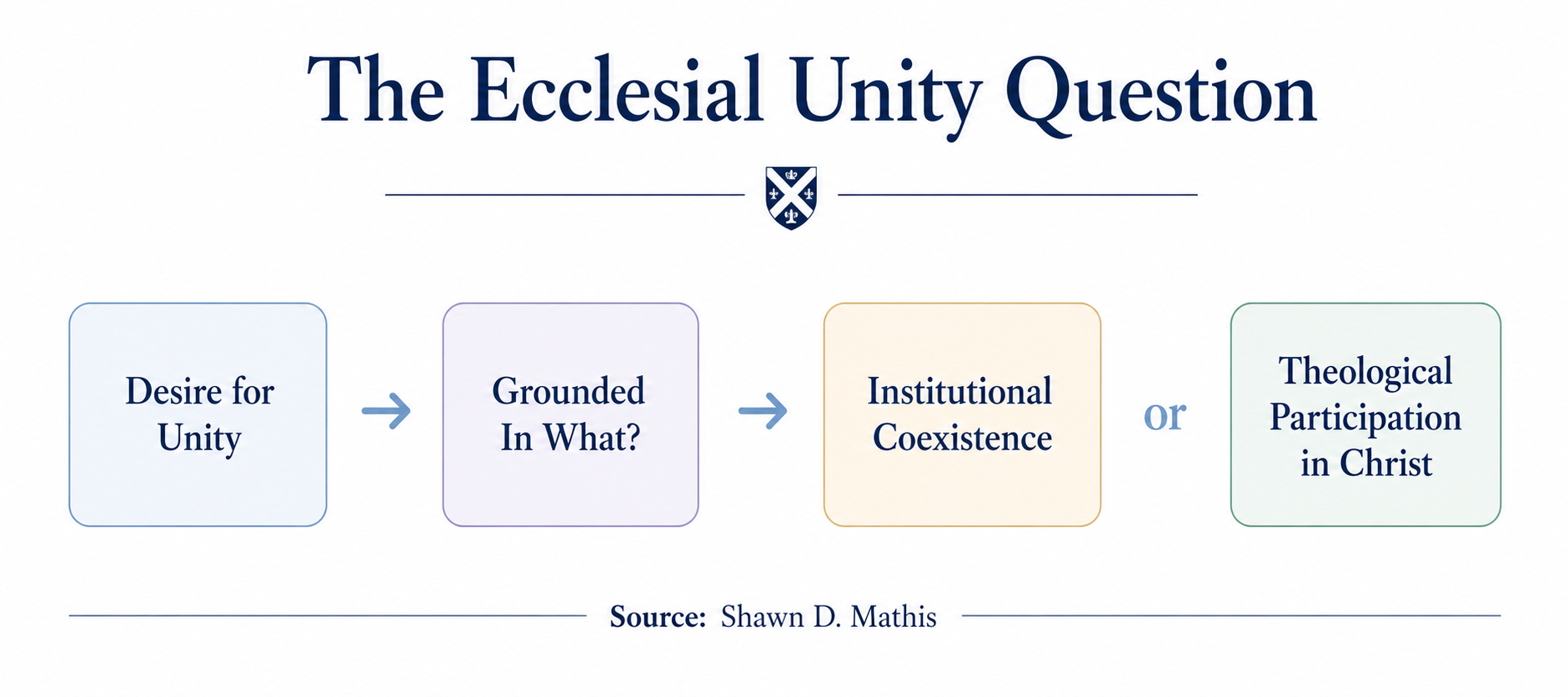
If coexistence becomes detached from shared theological reasoning, canonical accountability, and serious engagement with the apostolic witness, unity itself risks becoming increasingly procedural, therapeutic, or institutional rather than theological.
The interpretive challenges confronting the modern church are not identical to those faced a century and a half ago. Faithfulness to Scripture requires not only continuity with the theological seriousness of the Restoration tradition but also renewed scholarly engagement, philological care, canonical attentiveness, and the capacity to apply enduring biblical truths responsibly within a rapidly changing world.
Such work cannot be delegated indefinitely to abstract institutions alone. It depends upon the intellectual seriousness, moral integrity, theological discipline, and spiritual maturity of those entrusted with teaching the church: ministers, elders, professors, and those responsible for theological formation within universities, Bible departments, and preacher-training programs. The future interpretive stability of the church will depend substantially upon whether these leaders remain capable of uniting doctrinal faithfulness with moral and theological wisdom under modern conditions of fragmentation and pressure.
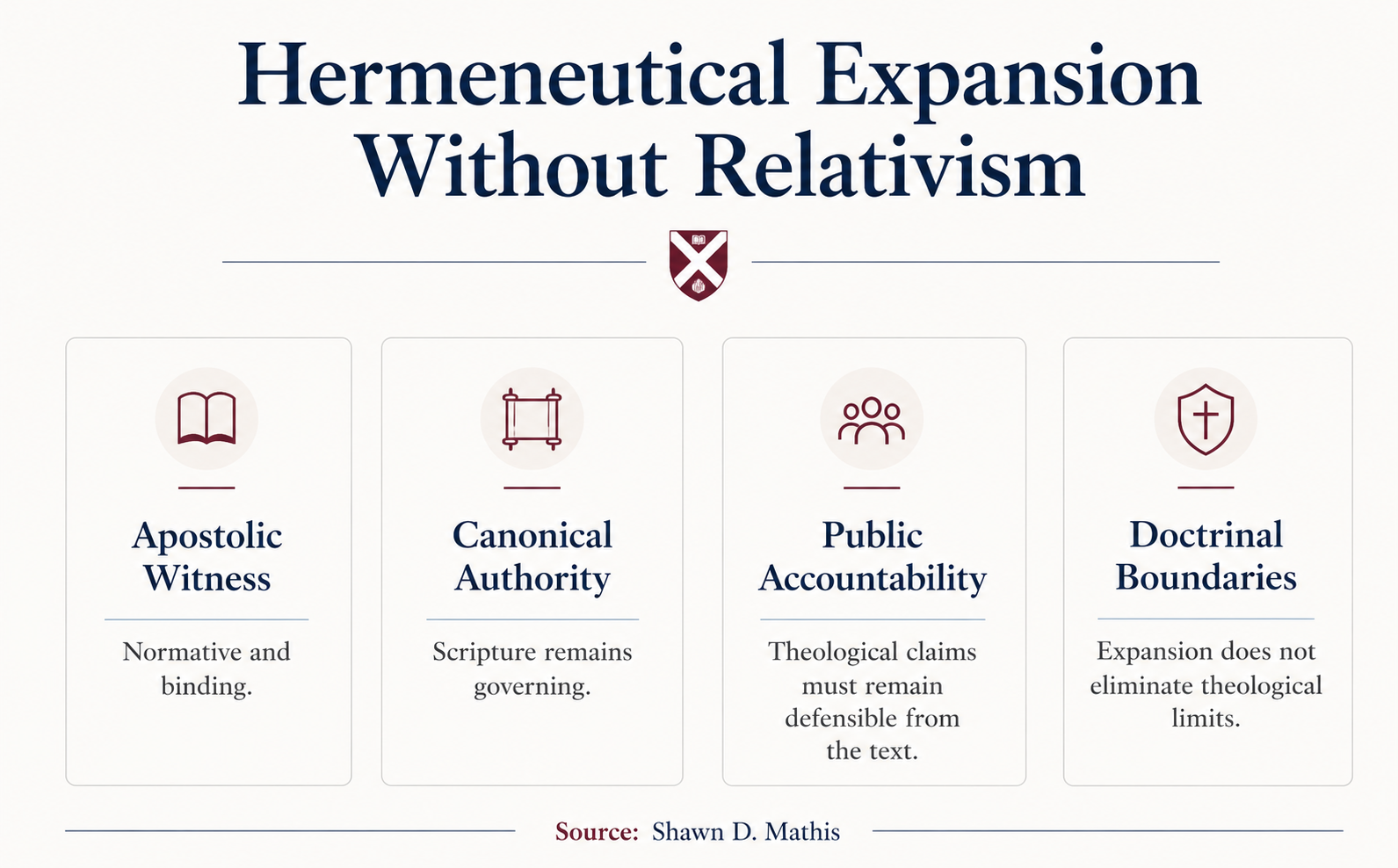
The apostolic witness remains normative, the canon remains authoritative, and New Testament Christianity remains the enduring theological aim of the church. The question is not whether doctrinal boundaries continue to exist, but whether the church’s interpretive framework is sufficiently robust to sustain those boundaries within the full theological depth and canonical complexity of Scripture itself.
Christ’s high priestly prayer remains deeply instructive here. Jesus prays ἵνα πάντες ἓν ὦσιν (“that they may all be one,” John 17:21, NA28). Yet the unity envisioned in John’s Gospel is not grounded in theological minimalism or mere institutional coexistence. It is grounded in participation within the life of God revealed through Christ himself: καθὼς σύ, πάτερ, ἐν ἐμοὶ κἀγὼ ἐν σοί (“just as you, Father, are in me and I in you,” John 17:21, NA28).
It requires intellectual humility, theological seriousness, philological care, canonical attentiveness, and sustained moral formation within the life of the church. It also requires acknowledging that Scripture is not merely a repository of isolated authorization units, but the witness to the crucified and risen Christ through whom the church itself comes into being.
The burden placed upon contemporary church leadership is therefore immense. Ministers, elders, professors, and theological educators now stand at the intersection of canonical interpretation, moral formation, institutional continuity, and cultural fragmentation. Their task is not merely administrative management or doctrinal preservation in abstraction. They are responsible for helping the church discern how fidelity to Christ, submission to Scripture, and truthful Christian living are to be sustained within the realities of the modern world. The future theological stability of the Churches of Christ may depend substantially upon whether such leadership remains spiritually mature, intellectually disciplined, morally credible, and deeply formed by the biblical canon itself.
If the church Christ died for is truly one, then that unity must ultimately rest not merely upon institutional coexistence, but upon truthful participation in the apostolic gospel, faithful submission to the authority of Scripture, and continuing conformity to the resurrected Lord who stands at the center of the biblical canon itself. As Paul writes, αὐξήσωμεν εἰς αὐτὸν τὰ πάντα (“grow up in every way into him,” Eph. 4:15, NA28). Ecclesial maturity in the New Testament is not merely institutional preservation, but ongoing transformation into the life and character of Christ himself.